How to Choose an Acoustic Camera for Industrial Gas Leak Detection
Gas leaks in industrial plants are often invisible but their impact is not. This guide helps you structure your choice of acoustic camera based on what actually matters for your environment and use case.
Across industries, undetected leaks affect operations in four critical ways:
- Plant reliability: leaks reduce system performance, increase load on equipment, and can lead to unplanned downtime.
- Safety: depending on the gas, leaks may create explosion risks, asphyxiation hazards, or unsafe working conditions.
- Regulatory compliance: environmental and LDAR requirements increasingly demand documented detection, and in some cases quantification of emissions.
- Cost of lost gas: compressed air and industrial gases represent a continuous operational expense, and even moderate leaks can generate significant annual losses.
This is why the acoustic camera you invest in should be chosen based on which of these drivers aligns with your facility's priorities.
Key questions to ask yourself before investing in an acoustic camera
Before comparing models, clarify these points internally:
1. Who will use the camera? An expert team used to complex metrology tools — or operators for whom leak detection is one task among many?If users are not specialists in acoustic leak imaging (ALI), you'll want a camera that is forgiving, easy to use, and less dependent on manual settings.
2. How often will the camera be used? Occasional planned inspections (e.g. yearly LDAR campaigns) or frequent use for troubleshooting and reactive maintenance? If you can plan yearly inspections, a service provider may be preferable. If you need to react quickly, owning your ultrasound camera is often the better choice.
3. What level of performance do I need? Is it acceptable to miss some leaks, or do leaks directly affect plant reliability, safety, or compliance? If leaks impact reliability or efficiency, camera performance will be more critical. For environmental inspection, look for manufacturers with independently tested detection limits.
4. Do you operate in explosive atmospheres? If you plan to inspect areas where explosive gas mixtures may occur, you'll need to pay close attention to ATEX, IECEx, and other Ex certifications.
When acoustic cameras are not the right solution
Acoustic cameras are powerful tools for detecting gas leaks in industrial environments, but they are not designed for all applications. Understanding their limits is essential to selecting the right technology.
Practical takeaway: Selecting the right leak detection technology depends on the minimum leak rate you need to reliably detect, the risk associated with the gas, and the required inspection speed and coverage. Acoustic cameras are most relevant when inspections must be carried out efficiently across large or complex installations, while still providing precise leak localisation.
Safety First: Explosion Certifications and Digital Security
In many plants (refineries, petrochemical sites, gas storage, hydrogen facilities), operators may enter explosive atmospheres while performing inspections.
Key questions:
- Do you have explosive gases in the facility you want to inspect?
- Do you intend to use the camera inside these classified areas?
- Does your company require ATEX, IECEx, UL or other certifications?
Explosion-proof design ensures that the camera cannot become a source of ignition. ATEX and IECEx classify areas into Zones (0, 1, 2) depending on how often explosive gas atmospheres are present, while other systems (like UL Divisions in the USA) use a different classification but similar concepts.
Beyond explosion safety, ultrasound cameras are digitally enabled products. Your company will likely ask:
- How is inspection data stored and transmitted?
- Where are servers located (on-prem, EU, US)?
- Which cyber-security standards does the vendor comply with?
Detection Performance and Leak Rate Quantification
Not all acoustic cameras use the same:
- microphone sensors
- number of microphones
- acoustic imaging algorithms
This leads to significant differences in detection performance, especially in real industrial environments.
- Detection limits are often specified under controlled conditions:
- defined distance
- controlled background noise
- simple leak geometry (pinhole)
However, these conditions rarely reflect real industrial environments. In practice, performance is strongly influenced by:
- background noise (compressors, turbines, flow noise)
- complex geometries (flanges, valves, fittings)
- distance and accessibility
As a result, a system that performs well in laboratory conditions may show significantly reduced performance in the field.
For this reason, it is essential to evaluate performance based on real industrial use cases, not only on specification sheets.
When comparing solutions, consider:
- documented results in environments similar to your own
- field references or case studies
- demonstrations under realistic conditions
Leak rate quantification
Some acoustic cameras provide leak rate estimates (L/h, SCFM, kg/h) based on acoustic measurements.
This can support:
- prioritisation of maintenance actions
- monitoring of leak evolution over time
- estimation of financial losses
- emissions reporting
However, not all quantification approaches are equivalent. Accurate estimation requires models that take into account:
- accurate distance between the camera and the leak
- gas type
- system pressure
- leak geometry
If these parameters are not properly considered, leak rate estimates can be highly inaccurate, with errors potentially reaching orders of magnitude.
The geometry and size of the acoustic sensor array also play a role. Smaller arrays typically provide lower accuracy of distance estimation, especially at larger distances.
Since distance is a key parameter in leak rate estimation, inaccuracies in distance measurement can directly impact the reliability of the quantified leak rate.
When evaluating solutions, it is therefore important to understand:
- which physical parameters are used in the model
- how the model has been validated
- and whether results are consistent in real industrial conditions
Ease of Use, Angle of View and Imaging Capabilities
Even the most powerful ultrasound camera is ineffective if operators struggle to use it in the field.
Points to assess:
- Lightweight designs reduce fatigue during long inspections.
Two-handed operation
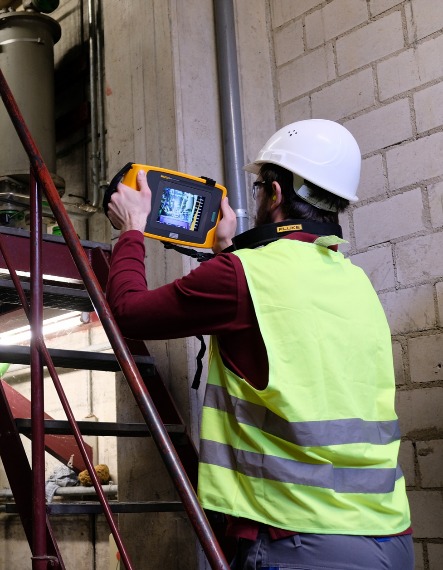
Two-handed operation
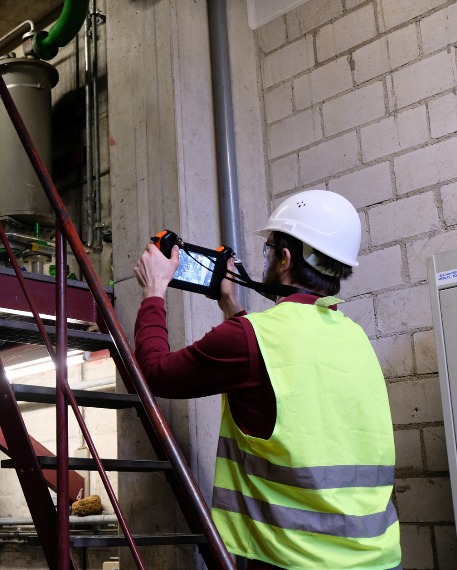
Two-handed operation
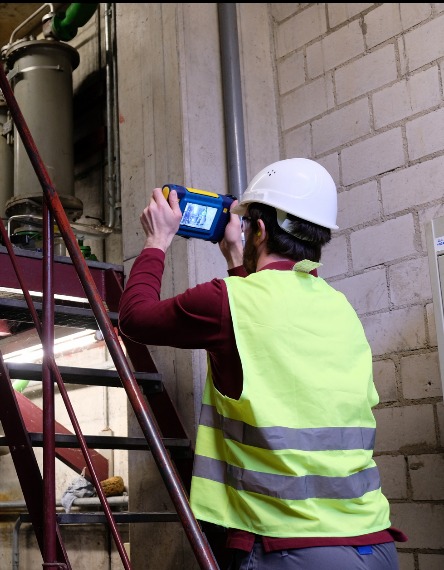
One-handed vs two-handed design
A one-handed camera allows the operator to keep one hand on the railing. One-handed devices are safer and more comfortable when climbing stairs, using ladders, or working in confined spaces.
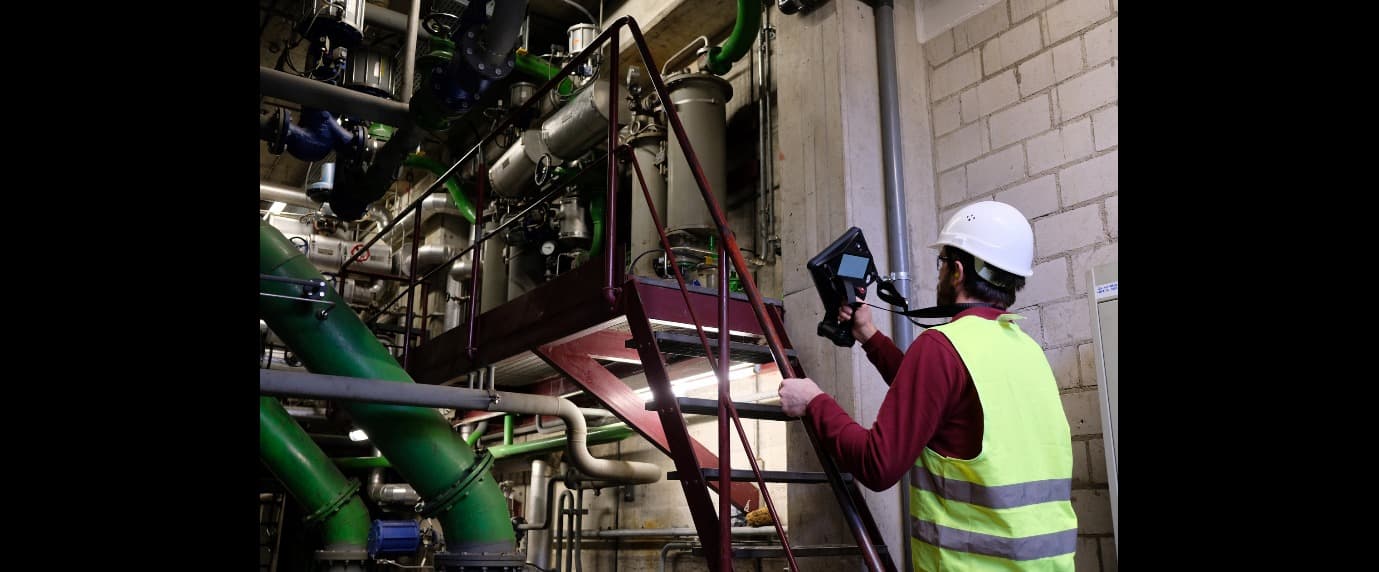
Optical field of view (FOV)
- A narrow FOV (e.g. 60–70°) may be acceptable for small, controlled areas.
- For large industrial plants, a wide FOV (around 150°) makes it easier to see more equipment at once, detect several leaks simultaneously, and reduce blind spots and human error.
Acoustic focus
- Manual focus requires the operator to estimate the distance to the leak.
- Acoustic autofocus automatically adjusts to the sound source distance, removing guesswork and helping to avoid accidentally “blurring” leaks out of the acoustic image.
Lighting
- Integrated LEDs are extremely helpful in dark or partially lit areas, making the optical image usable for documentation.
Reporting, Calibration and Long-Term Support
Finding leaks is only half the story. In many organizations, other teams (maintenance, operations, HSE, management) will rely on clear, traceable reporting.
Important aspects:
- Photo and video quality
- Colour images with a wide angle of view help quickly identify the exact leaky element and read asset tags.
- Embedding gas type and estimated leak rate directly in the image or video makes it “self-explanatory”.
- File formats and transfer
- Standard formats (JPEG, MP4) avoid IT headaches.
- USB, Wi-Fi or Bluetooth must comply with your IT/security policies.
- Ideally, the camera won’t delete files automatically after transfer.
- Reporting tools
- Simple workflows to generate reports with images, leak rates and annotations (tags, PNID references, equipment IDs).
- Calibration
- Opto-acoustic calibration (alignment between optical and acoustic images) over the whole field of view (and not only on the center) and microphone array calibration are critical for accuracy and comparability over time.
- Regular calibration may be required by your metrology or quality department, especially if you rely on leak rate quantification.
Training and support
The effectiveness of acoustic leak detection depends not only on the device, but also on how it is used and interpreted in the field.
Key aspects to consider:
- Availability of training material and online courses, which may be sufficient for simple use cases such as compressed air leak surveys
- On-site training, often recommended for complex environments, regulatory applications, or service providers, where consistent and reproducible results are required
- Access to specialized support, particularly for challenging use cases (noisy environments, leak quantification, emissions reporting)
The level of expertise behind the solution can have a significant impact on the quality and reliability of the results. When evaluating vendors, it is worth considering whether support is provided by specialists in acoustic imaging, or as part of a broader portfolio of inspection technologies.
A Practical Checklist to Shortlist Ultrasound Cameras
Use this checklist when comparing vendors:
- ❑ Do we need an Ex-certified (ATEX, IECEx, UL) ultrasound camera?
- ❑ Has the detection performance been tested by independent laboratories?
- ❑ Does the camera provide realistic, documented leak rate quantification?
- ❑ Is the device single-handed and light enough for long inspections?
- ❑ What is the optical field of view? Are we comfortable with potential blind spots?
- ❑ Is there acoustic autofocus, and how is dynamic range handled?
- ❑ Does the camera include integrated LEDs for low-light inspections?
- ❑ Are images/videos in standard formats? How are files transferred and stored?
- ❑ What calibration processes and intervals are recommended?
- ❑ What training and support packages are available (online, on-site, refreshers)?
Frequently Asked Questions
Ready to choose the right ultrasound camera?
Use our buyer's checklist to shortlist vendors, or speak with a Distran expert to find the right solution for your facility.